Overview of Challenges in E-Commerce
E-commerce companies often struggle with a range of operational difficulties, including:
- Order Processing Delays: Slow order fulfillment can lead to frustrated customers, decreased sales, and potential loss of trust.
- Inventory Management Issues: Maintaining accurate stock levels to prevent overstocking or stockouts is critical in a competitive market.
- Customer Service Bottlenecks: High volumes of customer inquiries, especially during peak periods, can overwhelm staff and affect response times.
- Integration of Systems: Many businesses utilize multiple platforms for various functions, leading to disjointed workflows.
Addressing these challenges is essential for maintaining competitiveness and ensuring customer satisfaction. Fortunately, AI offers effective solutions through automation for these mundane yet crucial tasks.
How AI Can Streamline Workflows
AI technology can significantly enhance e-commerce operations by automating repetitive processes. Here are some key areas where AI can make a difference:
Order Processing Automation
AI agents can expedite order processing by automatically pulling data from various systems, updating inventories, and triggering shipping processes. This reduces the time taken from order placement to fulfillment.
Inventory Management Optimization
With AI workflow automation, businesses can use predictive analytics to forecast demand accurately. By integrating with existing databases, AI can suggest optimal inventory levels, minimizing both overstock and stockouts.
Enhancing Customer Interactions
AI-powered chatbots can handle a significant portion of customer service queries, providing instant responses and support without human intervention. This not only improves response times but also frees up staff to deal with more complex issues.
Seamless System Integration
AI can connect disparate systems, enabling a smooth flow of information between various business platforms, including CRM, e-commerce, and logistics management tools. This reduces manual data entry and inconsistencies across platforms.
Case Studies of Successful AI Implementation
Many e-commerce businesses have successfully adopted AI workflow automation to transform their operations. Here are a few notable examples:
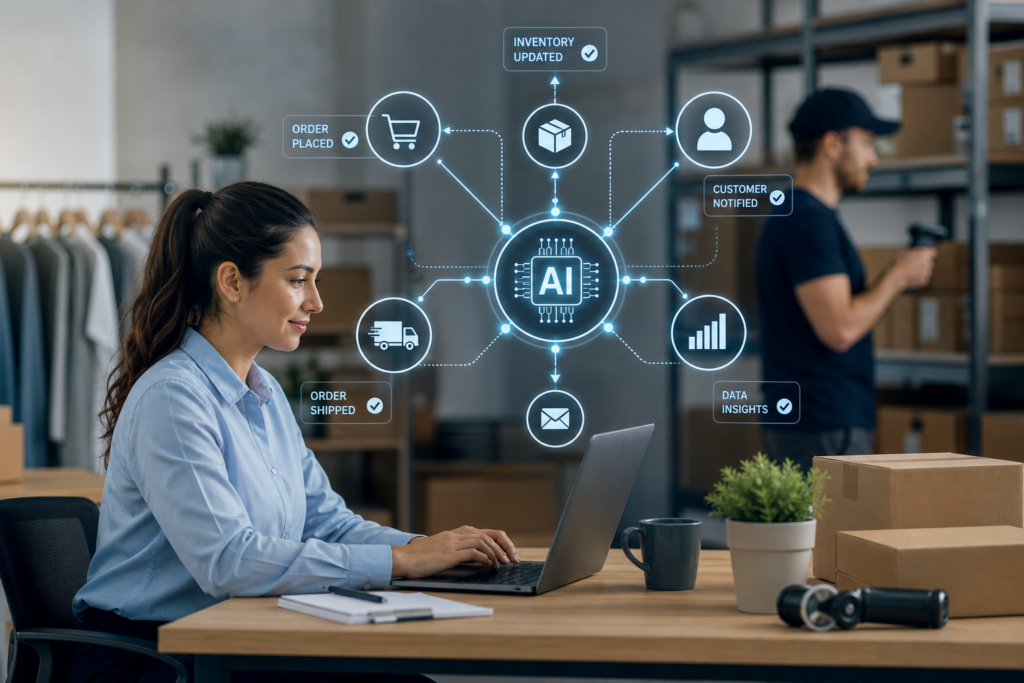
Case Study 1: Retailer X
Retailer X implemented an AI-driven order processing system that reduced fulfillment time by 50%. By integrating AI with their existing ERP system, they automated inventory updates and streamlined order tracking, significantly improving customer satisfaction.
Case Study 2: E-Commerce Y
E-Commerce Y adopted AI chatbots to handle customer inquiries. This resulted in a 30% reduction in response times and allowed the customer service team to focus on complex queries, improving overall service quality.
Customizing AI Solutions for Unique Business Needs
Every e-commerce business is unique, and so are its operational challenges. Customizing AI solutions is crucial for achieving the best results. Consider the following when customizing your AI workflow:
- Identifying Key Pain Points: Analyze your operations to determine which areas could benefit the most from automation.
- Integrating Existing Systems: Ensure any new AI solution works seamlessly with your current software to avoid disruptions.
- Consulting with Specialists: Work with specialists like SamSiyu to design a custom AI agent tailored to your specific business processes.
Steps to Start an AI Automation Project for E-Commerce
Getting started with AI automation can seem daunting, but following these steps can simplify the process:
- Assess Your Current Workflows: Identify repetitive tasks and areas where automation could provide immediate benefits.
- Define Clear Objectives: Establish what you hope to achieve with AI automation, such as faster order processing or improved customer service.
- Research Solutions: Explore various AI technologies available in the market, focusing on those that best meet your needs.
- Engage a Professional: Consult with an expert, like SamSiyu, to evaluate your workflows and propose tailored solutions.
- Implement and Monitor: Begin with pilot programs to test the effectiveness of your AI solutions, monitoring and making adjustments as necessary.
FAQ
What is AI workflow automation?
AI workflow automation involves using artificial intelligence technology to automate repetitive tasks in business processes, allowing for improved efficiency, reduced errors, and streamlined operations.
How can AI benefit e-commerce businesses?
AI can help e-commerce businesses by automating order processing, optimizing inventory management, enhancing customer interactions, and integrating various systems, leading to improved efficiency and customer satisfaction.
Are AI solutions customizable for different e-commerce needs?
Yes, AI solutions can be tailored to meet the unique needs of different e-commerce businesses, ensuring they effectively address specific operational challenges.
Transform Your E-Commerce Operations
Integrating AI workflow automation into your e-commerce strategy can lead to significant improvements in efficiency and customer satisfaction. By addressing operational challenges with tailored solutions, businesses can streamline processes and focus on growth. If you’re considering implementing AI agents to enhance your business, reach out to SamSiyu for a practical discussion about how custom automation can improve your workflows. Share your repetitive processes with us, and let’s explore the potential for automation together.